2.2 Organisational Structure
Examiner Focus: Master the structural building blocks (hierarchy, chain of command, span of control, delegation, centralisation vs decentralisation). Contrast Mechanistic vs Organic approaches, evaluate the 4 structural designs (Simple, Functional, Divisional, Matrix), and explain why structure must follow strategy.
1. Real-World Case Dilemma
Case Context: A successful Singapore gaming hardware company grew from 10 founders in an industrial unit to 300 employees across 5 Asian countries within 3 years. The founder insisted on approving every single expense above $500, every marketing poster, and every job hire.
As a result, product launch approvals took 4 months, top software engineers quit in frustration due to lack of autonomy, and competitors beat them to market. Why did an organizational structure that generated startup success become the primary bottleneck threatening corporate survival?
2. Key Terms & Jargon Decoder
| Syllabus Term | Plain English Meaning | Examiner Trap / Distinguishing Feature |
|---|---|---|
| Span of Control | The number of direct subordinates reporting directly to a single manager. | Wide span: Manager supervises many subordinates
(flatter structure). Narrow span: Manager supervises few subordinates (taller hierarchy). |
| Chain of Command | The unbroken line of authority running from the top executive down to frontline workers. | Long chain of command = multiple management layers \rightarrow communication distortion and slow decisions. |
| Delegation | The passing of authority (decision-making power) down to a subordinate for specific tasks. | The manager remains 100% accountable for the final outcome. You delegate authority, but you cannot delegate ultimate accountability! |
| Centralisation vs Decentralisation | Centralised: Key decisions retained strictly by top
executive headquarters. Decentralised: Decision-making power pushed down to local unit / branch managers. |
Centralisation guarantees consistency and control; Decentralisation fosters speed, local responsiveness, and employee motivation. |
| Mechanistic vs Organic | Mechanistic: Rigid, tall, formal rules, centralized
authority (like a machine). Organic: Flexible, flat, few formal rules, decentralized teamwork (like a living organism). |
Mechanistic suits stable, standardized mass production; Organic suits dynamic, fast-changing tech and creative industries. |
3. Concept & Visual Anchor
Tall vs Flat Organisational Hierarchies
- Tall Structure (Narrow Span of Control): Multiple hierarchical management layers, long chain of command (slower communication), close supervision, high management salary overheads.
- Flat Structure (Wide Span of Control): Few hierarchical layers, short chain of command (rapid communication), wide spans of control, greater worker empowerment, lower management costs.
The 4 Structural Designs: Comparative Analysis
The 4 Structural Designs: Comparative Analysis
1. Simple Structure
- Found in micro-businesses and start-ups (1 founder directly manages all staff).
- Strength: Instant decision-making, zero bureaucracy.
- Limitation: Severely bottlenecks as the business expands past 15–20 workers.
2. Functional Structure
- Grouped by specialized business departments (Marketing, Operations, HR, Finance).
- Strength: High technical expertise, clear career progression within functions.
- Limitation: “Functional Silos” — departments compete and fail to communicate.
3. Divisional Structure
- Grouped into self-contained semi-autonomous business units by:
- (a) Geographic Territory: e.g. Singapore, Malaysia, China regional divisions.
- (b) Product Line: e.g. Full-Service Airline vs Budget Airline division.
- (c) Customer Segment: e.g. Retail Banking vs Corporate Banking division.
- Strength: Excellent local/product responsiveness and direct divisional accountability.
- Limitation: Expensive duplication of overheads (every division runs its own HR/Finance teams).
4. Matrix Structure
- Dual-reporting structure combining Functional Expertise (Vertical) with Cross-Functional Project Teams (Horizontal).
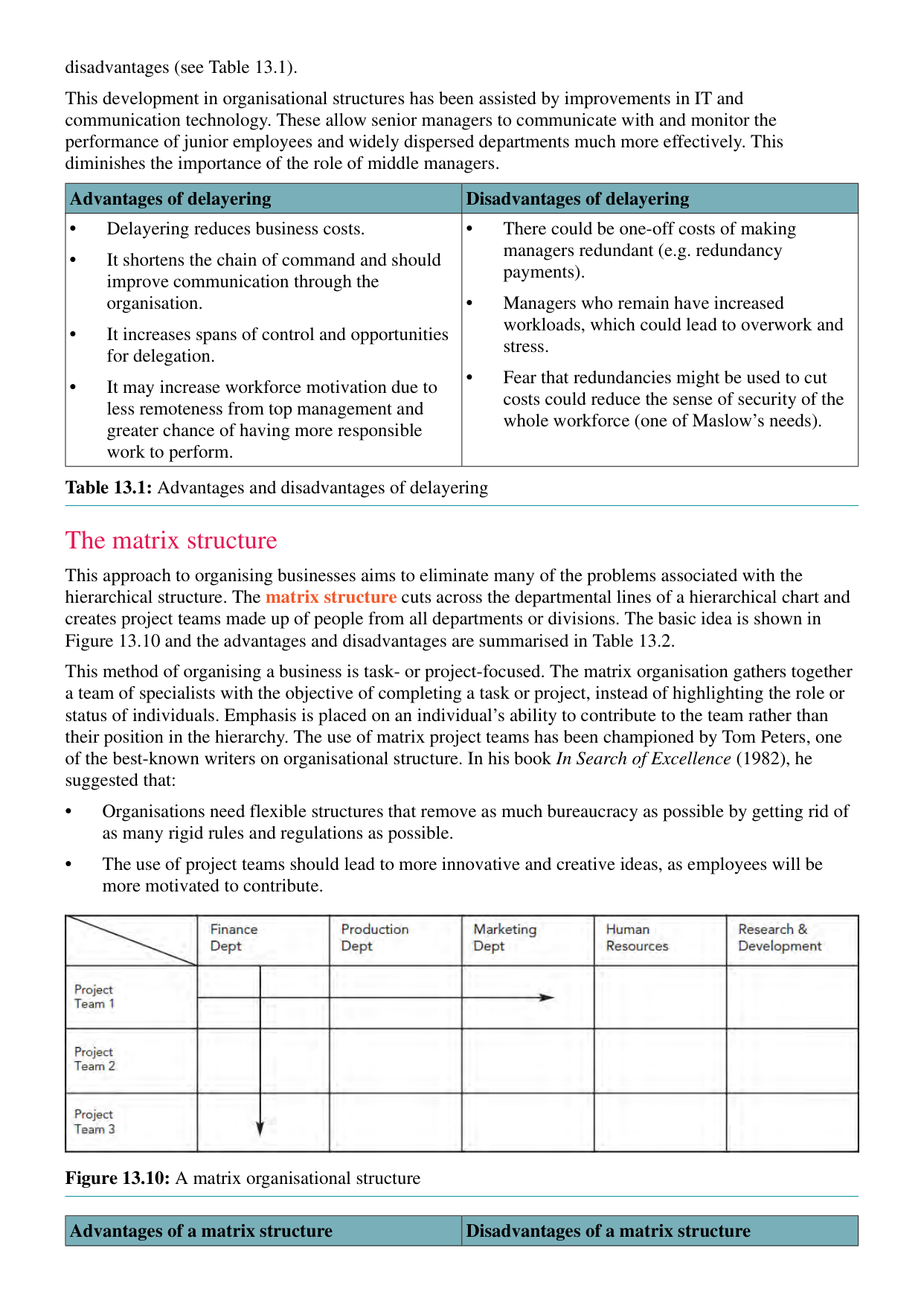
Matrix Structure Evaluation
- Strengths: Eliminates functional silos; highly flexible; deploys specialized talent dynamically across critical client projects.
- Vulnerabilities: Dual command conflict (employees have two bosses: a Functional Department Head and a Project Manager); ambiguous authority can trigger political power struggles and employee stress.
4. Check Your Understanding
🧠 Scenario:
A fast-expanding tuition centre chain in Singapore with 12 branches operates with a highly centralised structure: the founder personally writes every weekly worksheet, sets branch opening hours, and handles all parent refund requests. Branch managers are strictly forbidden from altering lesson schedules or offering customized makeup lessons.
- Identify two operational problems resulting from this centralized structure.
- If the centre decentralizes decision-making to Branch Managers, what is the major risk the founder faces?
- How can the founder balance decentralization while protecting brand quality?
👉 Click to reveal model answer & explanation
- Two Operational Problems: (a) Decision-making paralysis/delays: Parents wait days for simple refund approvals, causing customer churn; (b) Demotivation of branch managers: Talented center managers feel micromanaged and quit.
- Major Risk of Decentralization: Inconsistency in service quality: Individual branch managers may set conflicting standards or lower lesson rigor, damaging the tuition chain’s unified brand reputation.
- Balancing Solution: Empower branch managers to handle operational scheduling and refunds up to $500 (Decentralization), while enforcing centralized curriculum materials, standardized grading rubrics, and monthly KPI performance audits (Centralized Control).
5. Exam Error Surgery: Fix the Weak Answer
Paper 1 Section B Prompt (10 marks): Evaluate the impact of delayering on a business and its employees.
“Delayering is when a company fires middle managers to save money. The structure becomes flat so the company is smaller. This is good because the company saves a lot of salary. Workers are also happy because they can talk to the top boss directly. However, workers have more work to do. So delayering is good for profit.”
🔴 Examiner Red-Pen Diagnosis:
- Inaccurate Definition (): Defines delayering as “making the company smaller” (confuses delayering [removing hierarchical management tiers] with downscaling output).
- One-Sided Assumptions (): Assumes workers are automatically happy, ignoring severe workplace stress, wider spans of control, and lack of supervisor support.
- Lacks Critical Evaluation (): Ignores redundancy severance costs and loss of organizational institutional knowledge.
[Analysis: Financial & Communication Benefits of Delayering]
Delayering involves removing one or more intermediate tiers of middle management from an organizational hierarchy, converting a tall structure into a flatter organization. This delivers immediate financial overhead reductions by eliminating expensive managerial salaries. Operationally, shortening the chain of command eliminates distortion in vertical communication, enabling market feedback from frontline workers to reach executive directors rapidly. Furthermore, flattening the hierarchy widens spans of control, forcing senior management to delegate decision-making authority, which enriches frontline job roles and enhances employee empowerment.
[Analysis: Operational Drawbacks & Employee Stress]
However, delayering carries severe operational risks. Widening spans of control means remaining managers are overstretched, reducing the time available to mentor, coach, and supervise subordinates, which can lead to escalating error rates in complex tasks. For frontline employees, delayering frequently results in work intensification—absorbing administrative duties previously handled by middle managers without commensurate pay rises. Additionally, removing management tiers eliminates clear promotional pathways, demotivating ambitious career-oriented staff.
[ Evaluative Judgment & Synthesis]
In conclusion, the success of delayering depends critically on workforce capability and digital infrastructure:
- Delayering is highly effective in organizations with skilled, self-motivated professionals supported by digital enterprise resource planning (ERP) software that automates routine monitoring.
- In contrast, in organizations staffed by inexperienced or low-skilled workers requiring constant close supervision, delayering triggers operational chaos, poor quality control, and customer defection that far exceed the managerial salary savings.
6. Strategic Evaluation Matrix
| Factor | Mechanistic Approach (Tall / Centralised) | Organic Approach (Flat / Decentralised) |
|---|---|---|
| External Environment | Stable, predictable, low technological disruption. | Volatile, fast-changing, high innovation velocity. |
| Business Strategy | Cost leadership via mass standardization (§6.3). | Differentiation via rapid customization & innovation (§6.3). |
| Workforce Skill Level | Low-skilled, routine execution, high turnover. | Highly educated, specialized knowledge workers. |
| Decision Speed Priority | Standardized compliance & zero-risk control. | Rapid local responsiveness & customer adaptability. |
7. “I Do / We Do / You Do” Exam Scaffolds
“I Do” Annotated Model Answer (12 marks)
Question: Evaluate whether a multinational retail company should transition from a functional organizational structure to a divisional structure by geographic region.
[/ Definition & Context]
A functional structure organizes human capital by specialized operational departments (Marketing, Finance, Ops, HR), whereas a geographic divisional structure organizes business units into autonomous regional entities (e.g. Southeast Asia, East Asia, Europe).
[ Analysis: Case for Geographic Divisional Structure]
Transitioning to a geographic divisional structure is critical when an expanding multinational encounters diverse socio-cultural consumer tastes and varied legal environments. Local divisional directors possess intimate knowledge of domestic market trends, consumer preferences, and local advertising regulations, allowing them to tailor marketing mixes and product assortments with high speed and agility without waiting for distant head-office approval. Furthermore, each regional division operates as a distinct profit center, creating clear executive accountability for regional financial performance.
[ Analysis: Case Against Geographic Division (Duplication & Silos)]
However, geographic divisional structures generate expensive operational duplication. Each regional division must establish its own dedicated finance, marketing, and HR teams, significantly inflating total corporate administrative overheads. Furthermore, global purchasing economies of scale may be fragmented if regional buyers procure independently, weakening bargaining power over global suppliers. Regional divisions may also develop conflicting brand identities, diluting the global corporate image.
[ Evaluative Judgment]
In conclusion, the transition is justified only when regional market differences are profound:
- If consumer tastes, dietary habits, and retail channels vary substantially across countries (e.g. food and fashion retail), geographic divisionalization is essential to prevent commercial irrelevance.
- To mitigate overhead duplication, management should implement a hybrid matrix model: decentralizing product merchandising to regional divisions while retaining centralized global procurement and treasury functions at corporate headquarters.
“We Do” Guided Practice Scaffold
Question: Explain one benefit and one limitation of a matrix organizational structure for a tech firm developing multiple new smartphone apps (6 marks).
Complete the analytical sentences using the provided sentence frames:
- [Benefit - Cross-Functional Agility] A matrix structure allows the tech firm to combine functional software engineering specialists into dynamic project teams, which improves innovation because \dots (Hint: explain how cross-functional collaboration between marketing and software design breaks down functional silos).
- [Limitation - Dual Command Conflict] An app developer in a matrix structure reports to both a Functional Engineering Head and a Product Project Manager, which creates conflict when \dots (Hint: explain what happens when the two bosses assign competing deadlines or conflicting technical priorities).
“You Do” Independent Exam Practice
25-Mark Essay Prompt: “Evaluate the view that organizational structure is the single most important factor determining whether a corporate strategy can be successfully implemented.”
Guided Success Criteria:
8. Self-Diagnosis & Retrieval Matrix
| Syllabus Sub-Topic | Can I explain in Plain English? | Can I provide a Singapore Case? | Can I evaluate the Trade-off? |
|---|---|---|---|
| Hierarchy & Spans of Control | ⬜ | ⬜ (Tall civil service vs Flat tech start-up) | ⬜ (Supervision rigor vs Overhead cost) |
| Delegation vs Accountability | ⬜ | ⬜ (Founder delegating daily outlet ops) | ⬜ (Empowerment vs Loss of control) |
| Centralisation vs Decentralisation | ⬜ | ⬜ (Tuition chain / Bank branch policies) | ⬜ (Brand consistency vs Local agility) |
| Mechanistic vs Organic | ⬜ | ⬜ (Factory line vs Creative design agency) | ⬜ (Standardization vs Creative innovation) |
| 4 Structural Designs (Matrix focus) | ⬜ | ⬜ (SIA / Tech project matrix teams) | ⬜ (Cross-functional synergy vs Dual command) |