2.5 Motivation Theories & Reward Systems
Examiner Focus: Master the distinction between Extrinsic and Intrinsic rewards. Deep-dive into the 3 official Needs Theories (Maslow, Herzberg, McClelland) and the 2 Process Theories (Expectancy Theory, Equity Theory). Critically evaluate Financial vs Non-Financial incentives and design tailored motivational packages for diverse workforce profiles.
1. Real-World Case Dilemma
Case Context: A leading Singapore investment bank offers junior software analysts a massive annual salary of S$140,000 plus an annual cash bonus of S$30,000. Despite this elite compensation, 50% of junior analysts quit within 18 months, citing 90-hour workweeks, lack of constructive feedback, micro-management, and a toxic culture of internal blame.
If money is the ultimate motivator, why does offering record-high financial compensation fail to prevent employee burnout, demotivation, and mass resignations?
2. Key Terms & Jargon Decoder
| Syllabus Term | Plain English Meaning | Examiner Trap / Distinguishing Feature |
|---|---|---|
| Extrinsic Rewards | Tangible, external rewards provided by the organization (e.g. base salary, cash bonuses, corporate title, medical benefits). | Effective at attracting staff and satisfying lower-order physiological/safety needs; rapidly suffers from diminishing motivational returns. |
| Intrinsic Rewards | Internal, psychological satisfaction derived directly from the work itself (e.g. sense of accomplishment, autonomy, pride, craft mastery). | Creates deep, long-lasting employee commitment; cannot be bought directly with cash. |
| Hygiene Factors (Herzberg) | Workplace conditions (pay, job security, company policy, working conditions) whose absence causes severe dissatisfaction, but whose presence does NOT actively motivate. | Raising salary stops workers from complaining, but will not make them work harder or innovate. |
| Motivators (Herzberg) | Higher-order factors (achievement, recognition, meaningful work, responsibility, personal growth) that actively drive high performance. | True motivation only occurs when Motivators are present. |
| Expectancy Theory (Vroom) | Motivation is a multiplier: \text{Effort} \rightarrow \text{Performance} \rightarrow \text{Reward}, and whether the reward is valued. | If an employee believes a target is impossible (\text{Effort} \rightarrow \text{Performance} = 0), motivation collapses to zero, no matter how big the bonus. |
| Equity Theory (Adams) | Employees compare their personal \frac{\text{Outcomes (Rewards)}}{\text{Inputs (Effort)}} ratio against colleagues. | Perceptions of unfairness (e.g. favoritism in bonus allocation) trigger immediate demotivation and deliberate reduction in effort. |
3. Concept & Visual Anchor
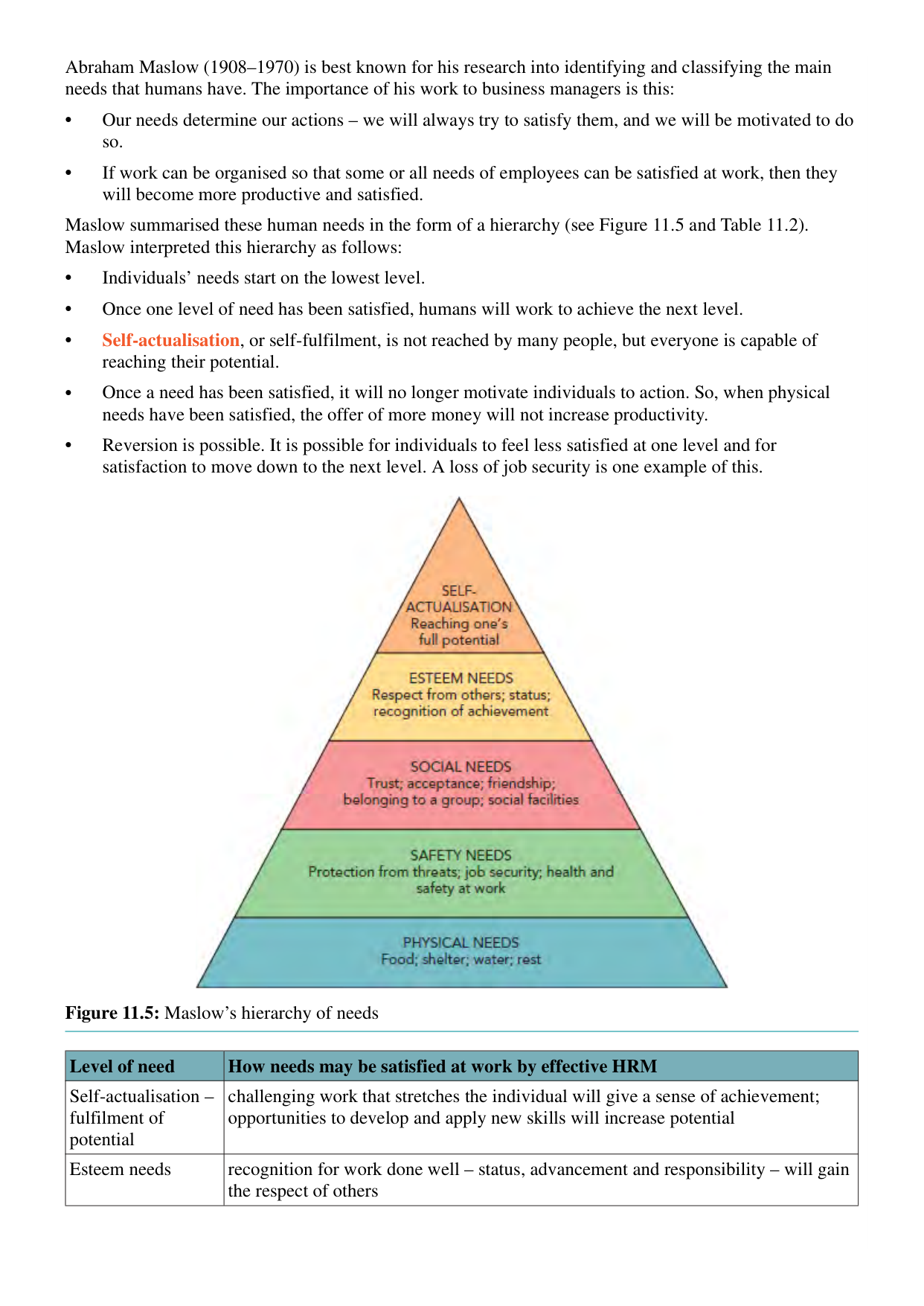
| Maslow Hierarchy Level | Herzberg Two-Factor Equivalent | Workplace Motivational Mechanism |
|---|---|---|
| 5. Self-Actualisation | Motivator (True Driver) | Challenging, purpose-driven work; creative autonomy |
| 4. Esteem Needs | Motivator (True Driver) | Recognition, job title, career promotion, responsibility |
| 3. Social / Belonging | Hygiene Factor (Baseline) | Supportive team culture, positive coworker relations |
| 2. Safety & Security | Hygiene Factor (Baseline) | Job security, safe workplace, clear company policies |
| 1. Physiological Needs | Hygiene Factor (Baseline) | Basic salary, fair wages, comfortable work environment |
Master Comparison of Motivation Theories
1. Needs Theories
- Maslow’s Hierarchy of Needs: 5-level hierarchical pyramid (Physiological \rightarrow Safety \rightarrow Social \rightarrow Esteem \rightarrow Self-Actualisation). Lower needs must be substantially satisfied before higher needs become primary motivators.
- Herzberg’s Two-Factor Theory: Hygiene Factors (prevent dissatisfaction) vs Motivators (actively drive high effort).
- McClelland’s 3 Learned Needs:
- Need for Achievement (nAch): Seeks challenging goals, personal accountability, and feedback.
- Need for Affiliation (nAff): Seeks warm interpersonal harmony and supportive teamwork.
- Need for Power (nPow): Seeks institutional influence, authority, and status.
2. Process Theories
- Expectancy Theory (Vroom):
\text{Motivation} = \text{Expectancy } (E \rightarrow P) \times \text{Instrumentality } (P \rightarrow R) \times \text{Valence } (V)
Expectancy (E \rightarrow P): “If I try hard, can I achieve the target?”
Instrumentality (P \rightarrow R): “If I achieve the target, will I receive the promised reward?”
Valence (V): “Do I actually value the specific reward being offered?”
Equity Theory (Adams):
\frac{\text{My Outcomes (Rewards)}}{\text{My Inputs (Effort)}} = \frac{\text{Colleague's Outcomes}}{\text{Colleague's Inputs}}
- Perceptions of unfairness (e.g. favoritism in bonus allocation) trigger demotivation and deliberate reduction in effort.
Financial vs Non-Financial Incentive Toolkit
| Incentive Type | Specific Methods | Key Advantages | Critical Limitations / Risks |
|---|---|---|---|
| Financial Incentives | • Performance-Related Pay (PRP) • Commission / Piece-Rates • Annual Profit-Sharing (e.g. Sheng Siong) • Share Options |
• Immediate, tangible impact on effort. • Directly aligns worker targets with sales/profit volume. |
• High recurring cost. • Encourages unethical shortcuts or quality neglect. • Fails to motivate beyond basic hygiene level. |
| Non-Financial Incentives | • Job Enrichment: Adding higher-level
responsibility and challenge. • Job Enlargement: Widening task variety. • Empowerment & Autonomy: Authority to make decisions. • Recognition Programs: “Employee of the Month”. • Training / SkillsFuture: Sponsoring diploma/degrees. |
• Fosters deep intrinsic motivation and loyalty. • Highly cost-effective (low financial outlay). • Elevates long-term workforce productivity and capability. |
• Requires mature, self-directed workers. • Ineffective if basic baseline pay is below living wage (Herzberg hygiene deficit). |
4. Check Your Understanding
🧠 Scenario:
A Singapore property agency introduces an aggressive 100% commission-only compensation scheme with zero base salary for new real estate agents.
- Top 5% of aggressive senior agents earn S$300,000/year.
- Bottom 70% of new agents struggle to close deals and earn less than $1,000/month.
- Within 6 months, customer complaints regarding deceptive advertising and aggressive sales tactics increase by 80%, and 60% of new agents resign.
- Using Maslow’s Hierarchy, explain why new agents are failing and quitting.
- Using Herzberg’s Two-Factor Theory, explain why 100% commission fails to foster ethical customer service.
- Recommend a redesigned compensation structure that balances motivation with ethical compliance.
👉 Click to reveal model answer & explanation
- Maslow Diagnosis: New agents cannot satisfy baseline Physiological and Safety needs (rent, food, income predictability). Operating in survival panic, they experience severe stress and quit.
- Herzberg Diagnosis: Commission is an extrinsic hygiene/reward factor. Without a baseline safety net, agents resort to unethical behavior to survive; it fails to foster intrinsic professional pride or long-term customer relationship building.
- Recommended Redesign: A Hybrid Compensation Model: A stable base salary (S$2,500/month) satisfying baseline hygiene/safety needs + moderate performance commission + non-financial customer satisfaction (CSAT) rating bonuses to incentivize ethical service.
5. Exam Error Surgery: Fix the Weak Answer
Paper 1 Section B Prompt (10 marks): Evaluate whether financial incentives are the most effective method for motivating employees in a service business.
“Money is the most effective motivator because everyone works for money. If a company pays high salary and big bonus, workers will work very hard because they can buy what they want. Non-financial rewards like praise or training cannot pay the bills. Therefore, financial incentives are always the best way to motivate.”
🔴 Examiner Red-Pen Diagnosis:
- Taylorist Over-Simplification (): Treats human beings purely as “economic animals” (ignoring 70 years of psychological motivation research: Herzberg, Maslow, McClelland).
- Zero Theoretical Grounding (): Fails to cite hygiene factors, intrinsic motivation, or expectancy mechanics.
- Biased, Unsubstantiated Evaluation (): Dismisses non-financial motivators without evaluating cost, task complexity, or professional skill levels.
[Analysis: Effectiveness of Financial Incentives for Baseline Needs]
Financial incentives (such as performance bonuses, commission, and profit-sharing) are highly effective in satisfying lower-order Physiological and Safety needs (Maslow), particularly for frontline, low-income service workers. Tying financial rewards directly to measurable performance outputs creates high Instrumentality (Vroom’s Expectancy Theory), providing clear, immediate extrinsic motivation to accelerate task completion speeds.
[Analysis: Severe Limitations of Financial Incentives (Herzberg & Diminishing Returns)]
However, according to Herzberg’s Two-Factor Theory, money functions primarily as a Hygiene Factor. While inadequate pay triggers severe dissatisfaction, increasing financial compensation beyond competitive market levels merely prevents dissatisfaction—it does not create sustained, proactive motivation. Over-reliance on financial bonuses often triggers destructive unintended consequences: workers focus exclusively on measurable quantity targets while neglecting unmeasured qualitative aspects (e.g. authentic customer care, teamwork, and ethics). Furthermore, financial bonuses rapidly suffer from the “hedonic treadmill” (employees view bonuses as an entitlement), inflating fixed operational overheads without yielding proportional productivity gains.
[Analysis: Superiority of Non-Financial Motivators for Higher-Order Needs]
In knowledge-intensive service industries, true discretionary effort is driven by Intrinsic Motivators—such as Job Enrichment, autonomy, public recognition, and career progression (Maslow’s Esteem and Self-Actualisation). Sponsoring certified upskilling (e.g. SkillsFuture courses) satisfies McClelland’s Need for Achievement (nAch), cultivating enduring corporate loyalty at a fraction of financial bonus costs.
[ Evaluative Judgment & Synthesis]
In conclusion, financial incentives are necessary as a foundation, but insufficient as a driver of excellence:
- Management must first provide fair, competitive base salaries to satisfy baseline hygiene requirements (preventing dissatisfaction and turnover).
- Beyond this baseline, superior long-term motivation is achieved through non-financial intrinsic motivators—empowering staff with operational autonomy, recognition, and meaningful career pathways.
6. Strategic Evaluation Matrix
| Workforce Profile | Primary Motivation Driver | Recommended Incentive Package |
|---|---|---|
| Low-Skilled / Temporary Workers (e.g. Event Ushers, Warehouse Packers) | Extrinsic / Physiological & Safety (Immediate cash income) | Competitive hourly wage + Attendance bonus + Piece-rate productivity bonus. |
| Sales Executives (e.g. Car / Property Sales) | Extrinsic / High Achievement (nAch) | Modest base salary + Progressive tiered commission + “Top Producer” public recognition. |
| Knowledge Professionals (e.g. Software Engineers, Doctors, Research Scientists) | Intrinsic / Self-Actualisation & Autonomy | High base salary (hygiene) + Project autonomy (20% innovation time) + Sabbaticals & Equity options. |
| Middle Management (e.g. Branch / Depot Managers) | Status, Esteem & Power (nPow) | Annual profit-sharing + Executive development programs + Greater strategic delegation. |
7. “I Do / We Do / You Do” Exam Scaffolds
“I Do” Annotated Model Answer (12 marks)
Question: Evaluate how a business can apply Vroom’s Expectancy Theory and Adams’ Equity Theory to improve employee motivation.
[/ Definition & Context]
Vroom’s Expectancy Theory defines motivation as a multiplicative function of Expectancy (E \rightarrow P), Instrumentality (P \rightarrow R), and Valence (V), while Adams’ Equity Theory states that motivation depends on employees perceiving fairness in their Outcome-to-Input ratio relative to peers.
[ Analysis: Applying Expectancy Theory]
To maximize Expectancy (E \rightarrow P), management must ensure that employees believe their effort will successfully achieve performance targets. Management accomplishes this by providing structured training, modern operational tools, and setting realistic SMART targets; if targets are perceived as unachievable, Expectancy becomes zero, destroying motivation. To secure Instrumentality (P \rightarrow R), the organization must build absolute trust that hitting targets will reliably yield promised bonuses. Finally, for Valence (V), management must offer flexible cafeteria-style rewards, allowing workers to select rewards they personally value (e.g. cash, extra leave, or childcare allowances).
[ Analysis: Applying Equity Theory]
Concurrently, management must apply Equity Theory by establishing transparent, objective performance appraisal systems (§2.3). If employees perceive that colleagues who exert less effort receive identical bonuses due to managerial favoritism (perceived inequity), high-performing workers experience cognitive dissonance and deliberately reduce their input effort or resign. Ensuring objective performance metrics (e.g. tracked sales volume or audited quality scores) restores perceived equity.
[ Evaluative Judgment]
In conclusion, applying these process theories requires a holistic systems approach:
- Expectancy Theory ensures that employees possess the confidence and desire to achieve individual goals.
- Equity Theory ensures that the social and relational environment remains perceived as just and fair. Failing to manage equity will neutralize even the most sophisticated Expectancy-based incentive scheme.
“We Do” Guided Practice Scaffold
Question: Explain how Herzberg’s Two-Factor Theory can guide a retail manager to improve sales staff motivation (6 marks).
Complete the analytical sentences using the provided sentence frames:
- [Addressing Hygiene Factors First] First, the manager must ensure that hygiene factors (such as fair baseline wages, comfortable break rooms, and clear company policies) are adequate, because if hygiene factors are poor \dots (Hint: explain why workers will be dissatisfied and complain regardless of any motivational schemes).
- [Introducing True Motivators] Second, once hygiene is stabilized, the manager must introduce true motivators (such as delegating store display responsibility and publicly recognizing top customer service), because \dots (Hint: explain how responsibility and recognition satisfy intrinsic needs to drive proactive sales effort).
“You Do” Independent Exam Practice
25-Mark Essay Prompt: “Evaluate the view that understanding psychological needs theories is far more valuable to a modern business leader than relying on financial reward systems.”
Guided Success Criteria:
8. Self-Diagnosis & Retrieval Matrix
| Syllabus Sub-Topic | Can I explain in Plain English? | Can I provide a Singapore Case? | Can I evaluate the Trade-off? |
|---|---|---|---|
| Extrinsic vs Intrinsic Rewards | ⬜ | ⬜ (Bank salary vs Work-life balance) | ⬜ (Cash cost vs Deep loyalty) |
| Maslow’s 5 Hierarchy Levels | ⬜ | ⬜ (Commission-only agent breakdown) | ⬜ (Lower-order vs Higher-order needs) |
| Herzberg Hygiene vs Motivators | ⬜ | ⬜ (Base salary vs Job enrichment) | ⬜ (Preventing complaints vs Driving effort) |
| Expectancy Theory (E \times I \times V) | ⬜ | ⬜ (Unrealistic KPI target collapse) | ⬜ (Target difficulty vs Worker belief) |
| Equity Theory (\text{In} / \text{Out}) | ⬜ | ⬜ (Bonus favoritism demotivation) | ⬜ (Transparency vs Individual bargaining) |