3.5 The Marketing Mix (4Ps & Strategic Pricing)
Examiner Focus: Master the integration of the 4Ps (Product, Price, Promotion, Place). Understand Goods vs Services and the Product Life Cycle (PLC) stages and extension strategies. Master New Product Pricing (Penetration vs Skimming) and the 4 official Existing Product Pricing strategies (Cost-based, Breakeven, Perceived Value, Psychological). Master the 5 promotional tools, Integrated Marketing Communications (IMC), and distribution channels (Direct vs Indirect).
1. Real-World Case Dilemma
Case Context: When Singapore gaming hardware giant Razer launches a new $350 wireless esports mouse:
Product: Precision optical sensor, lightweight carbon chassis, RGB lighting.
Price: Premium Price Skimming ($349.99 psychological price point).
Promotion: Exclusive influencer endorsements on Twitch, esports tournament sponsorships, and viral social media campaigns (IMC).
Place: Direct-to-Consumer (DTC) flagship webstore + selective specialty gaming boutiques.
If Razer slashed the price to $49 and sold the mouse in discount neighborhood dollar stores, unit sales volume might rise. Why would doing so instantly destroy Razer’s brand equity, profit margins, and long-term business survival?
2. Key Terms & Jargon Decoder
| Syllabus Term | Plain English Meaning | Examiner Trap / Distinguishing Feature |
|---|---|---|
| Marketing Mix (4Ps) | The coordinated set of tactical marketing tools (Product, Price, Promotion, Place) that a firm blends to produce the response it wants in the target market. | All 4Ps must be mutually consistent. A premium product with a cheap price and budget distribution creates brand confusion. |
| Product Life Cycle (PLC) | The stages a product passes through from launch to withdrawal: Introduction \rightarrow Growth \rightarrow Maturity \rightarrow Decline. | The marketing mix (price, promo, distribution) must adapt dynamically across each stage. |
| Price Skimming | Setting a high initial price at launch to maximize short-term revenue from early adopters and recover R&D costs, before lowering it later. | Only works if the product has high brand prestige, technological novelty, and high barriers to competitor entry. |
| Penetration Pricing | Setting an artificially low initial price at launch to undercut rivals, stimulate rapid trial, and capture massive market share quickly. | Requires large factory capacity and deep financial cash reserves to absorb initial low profit margins. |
| Integrated Marketing Communications (IMC) | Coordinating all promotional tools (ads, PR, sales promo, online) so they deliver a single, unified, and consistent brand message. | Inconsistent messaging across channels dilutes consumer trust. |
3. Concept & Visual Anchor
The 4P Marketing Mix Interlocking Framework
- Product: Quality, features, design, branding, packaging, and USP.
- Price: Pricing strategy (Skimming vs Penetration; Cost-based, Perceived Value, Psychological).
- Promotion: Integrated Marketing Communications (Advertising, Sales Promo, PR, Personal Selling, Online).
- Place: Distribution channels (Direct-to-Consumer vs Indirect Wholesalers & Retailers).
Part 1: Product & The Product Life Cycle (PLC)
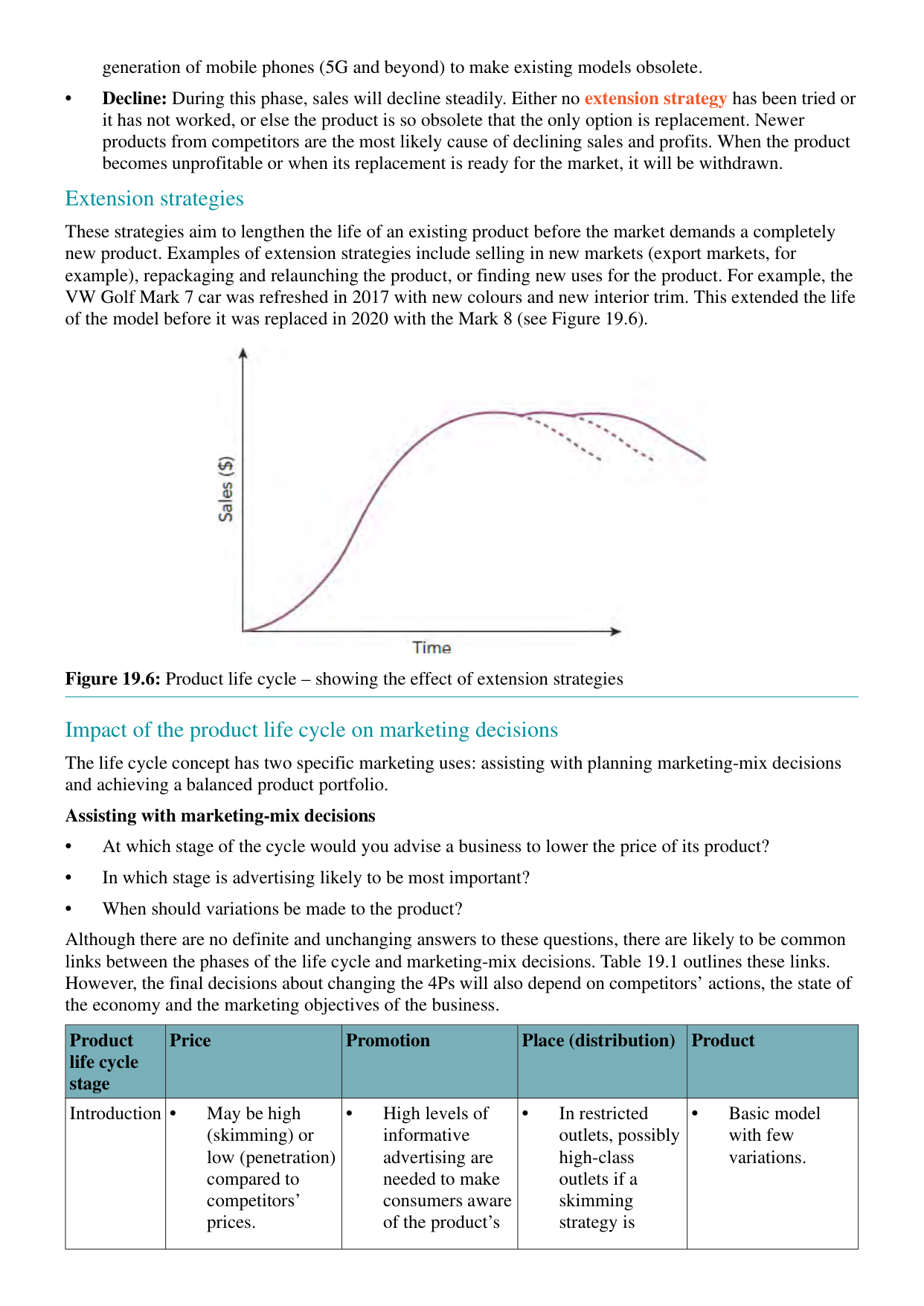
The Product Life Cycle (PLC) Strategic Progression
\text{Introduction (Launch)} \longrightarrow \text{Growth (Adoption)} \longrightarrow \text{Maturity (Cash Peak)} \longrightarrow \text{Decline / Extension}
Managing the Marketing Mix Across PLC Stages
| PLC Stage | Sales & Cash Flow | Primary Pricing Strategy | Promotional Objective | Distribution (Place) Strategy |
|---|---|---|---|---|
| 1. Introduction | Low sales volume; negative cash flow due to heavy launch R&D. | Price Skimming (if novel) OR Penetration Pricing (if crowded). | Heavy informative advertising; free sampling to build awareness. | Selective distribution; limited launch channels. |
| 2. Growth | Rapid sales growth; rising profit margins; cash flow turns positive. | Competitive pricing or gradual price stabilization. | Persuasive advertising; brand differentiation as rivals enter. | Expanding into intensive retail distribution channels. |
| 3. Maturity | Peak sales volume; plateauing growth; highest cash flow (Cash Cow). | Competitive pricing; promotional discounts; loyalty pricing. | Reminder advertising; sales promotions (discounts, bundles). | Mass, ubiquitous distribution; maximum retail shelf space. |
| 4. Decline | Falling sales volume; shrinking profit margins; customer defection. | Discount pricing to clear obsolete inventory; or price maintenance. | Minimal promotional spending (harvesting cash). | Rationalize channels; withdraw from unprofitable retailers. |
PLC Extension Strategies: Actions taken in the late Maturity stage to prevent a product from falling into Decline (e.g. rebranding, reformulating with low sugar, targeting new export markets [Ansoff], or discovering new product uses).
Part 2: Price & Strategic Pricing Methods
Internal vs External Factors Affecting Price:
- Internal Factors: Production & variable costs (§5.3), target profit margin, corporate objectives (survival vs market share), brand positioning (§3.4).
- External Factors: Competitor prices, price elasticity of demand, consumer disposable income, macro environment (GST rate, inflation).
The Official 9587 Pricing Toolkit
A. New Product Launch Pricing:
- Price Skimming: High initial price \rightarrow Maximizes revenue from price-inelastic early adopters \rightarrow Recovers heavy R&D (e.g. latest Apple iPhone launch).
- Penetration Pricing: Low initial price \rightarrow Maximizes rapid trial \rightarrow Captures dominant market share quickly \rightarrow Deters rivals.
B. Existing Product Pricing:
- Cost-Based Pricing:
\text{Price} = \text{Unit Variable Cost} + \text{Allocated Fixed Overhead} + \text{Profit Markup \%}
(Guarantees profit margin per unit, but ignores customer demand).
- Breakeven Pricing: Setting price to cover total fixed and variable costs at a specific target sales volume (Zero profit target).
- Perceived Value Pricing: Setting price based on the customer’s perceived worth of benefits rather than production cost (e.g. luxury dining, designer goods).
- Psychological Pricing: Pricing just below a round number (S$9.99 instead of S$10.00) to create an optical illusion of significantly lower cost.
Part 3: Promotion & Integrated Marketing Communications (IMC)
THE 5 PROMOTIONAL TOOLS
- Advertising: Paid, non-personal mass communication (TV, outdoor billboards, search).
- Sales Promotion: Short-term incentives to stimulate immediate purchase (coupons,
- 1-for-1 deals, seasonal discounts, flash sales).
- Personal Selling: Direct, face-to-face consultative selling (B2B machinery, wealth).
- Publicity & Public Relations (PR): Unpaid media coverage, press conferences, CSR.
- Online / Digital Promotion: Social media marketing, influencer sponsorships, SEO.
- Integrated Marketing Communications (IMC): The strategic coordination of all 5 promotional tools so that every customer touchpoint conveys an identical, mutually reinforcing brand message.
Part 4: Place (Distribution Channels)
The 3 Core Distribution Channels
- Direct Channel (Zero-Level): \text{Producer} \longrightarrow \text{Final Consumer} (e.g. Brand E-Commerce webstore; 100% brand control, maximum profit margin).
- 1-Level Indirect Channel (Retailer): \text{Producer} \longrightarrow \text{Retailer (e.g. FairPrice)} \longrightarrow \text{Final Consumer} (Broad physical reach; retailer takes margin cut).
- 2-Level Indirect Channel (Wholesaler + Retailer): \text{Producer} \longrightarrow \text{Wholesaler} \longrightarrow \text{Retailers} \longrightarrow \text{Final Consumer} (Mass distribution across thousands of small stores; lowest profit margin per unit).
4. Check Your Understanding
🧠 Scenario:
A Singapore start-up invents a patented, revolutionary smart water bottle that uses UV-C light to self-clean and track daily hydration via a smartphone app. Development took S$500,000 in R&D over 2 years.
- Unit production cost is $25.00.
- There are zero direct competitors on the market.
- The founder proposes setting a Cost-Based price of $30.00 (a 20% markup) and selling it through mass neighborhood discount toy shops.
- Why is the founder’s pricing and distribution strategy severely flawed?
- Recommend the appropriate New Product Pricing strategy and Distribution Channel.
- Justify how this aligns with the product’s positioning.
👉 Click to reveal model answer & explanation
Strategic Flaws:
- Cost-Based Pricing Flaw: Fails to capture consumer surplus. A revolutionary patented device can command high perceived value; pricing at S$30 leaves massive profit on the table and fails to recover the S$500,000 R&D investment.
- Distribution Flaw: Selling in discount toy shops degrades the premium, high-tech brand image and fails to reach the target health/tech-enthusiast demographic.
Recommended Strategy:
- Pricing: Price Skimming at S$99.00 (or S$99.90 psychological).
- Distribution (Place): Direct-to-Consumer (DTC) online store + selective premium electronics/lifestyle retailers (e.g. Challenger, Apple authorized resellers).
Justification: High price skimming captures maximum revenue from tech early adopters to rapidly recoup R&D costs, while premium distribution reinforces the product’s cutting-edge positioning.
5. Exam Error Surgery: Fix the Weak Answer
Paper 1 Section B Prompt (10 marks): Evaluate the circumstances under which penetration pricing is superior to price skimming for a firm launching a new consumer product.
“Penetration pricing is when you make the price very cheap to sell a lot. Price skimming is when you make it expensive. Penetration pricing is always better because consumers in Singapore like cheap things. If you charge a high price, no one will buy. So penetration pricing is the best choice.”
🔴 Examiner Red-Pen Diagnosis:
- Informal Definition (): Defines penetration as “making price very cheap” without explaining the strategic mechanism of capturing market share and erecting barriers to entry.
- Biased Generalization (): Claims no one buys high-priced goods, completely ignoring brand prestige, luxury goods, and price skimming R&D recovery.
- Zero Conditionality (): Fails to evaluate product novelty, capacity constraints, or brand equity.
[Analysis: When Penetration Pricing is Superior]
Penetration pricing (launching at a low initial price) is superior under specific structural market conditions:
- Highly Price-Elastic Demand with Established Substitutes: In crowded, mature consumer markets (e.g. packaged snacks or budget telecommunications), consumers are highly price-sensitive. A low introductory price stimulates immediate consumer brand-switching, accelerates market trial, and allows the firm to capture dominant market share rapidly.
- Massive Technical Scale Economies (§1.3): If the firm possesses massive factory capacity, high sales volumes rapidly drive down long-run average costs (LRAC), establishing a low-cost barrier that deters prospective rivals from entering.
[Analysis: When Price Skimming is Superior]
However, penetration pricing is completely inappropriate for innovative, highly differentiated products with heavy upfront R&D investments (e.g. cutting-edge electronics or patented pharmaceuticals). Under these conditions, Price Skimming is vastly superior:
- Recouping Heavy R&D: It exploits the price-inelastic demand of early adopters, maximizing gross cash flows to recover capital investments before competitor imitation occurs.
- Signaling Premium Quality: High launch prices establish high brand prestige and perceived value, whereas penetration pricing risks permanently cheapening the brand image.
[ Evaluative Judgment & Synthesis]
In conclusion, the choice between penetration and skimming depends strictly on product novelty and financial objectives:
- Penetration pricing is optimal for standardized products in mass, price-sensitive markets where rapid market share capture is the primary objective.
- Price skimming is essential for patented, premium innovations with constrained launch production capacity, where rapid capital recovery and luxury positioning take priority.
6. Strategic Evaluation Matrix
| 4P Dimension | Low-Cost / Mass Strategy (e.g. Scoot / Sheng Siong) | Premium / Differentiation Strategy (e.g. SIA / Razer) |
|---|---|---|
| Product | Standardized, functional, high durability, basic packaging. | Highly differentiated, bespoke features, luxury design, patented tech. |
| Price | Penetration pricing; Breakeven / Cost-plus pricing; price matching. | Price Skimming; Perceived Value pricing; Psychological price points. |
| Promotion | Mass sales promotions (discounts, 1-for-1 deals, cashback, flyers). | Sophisticated PR, VIP launch events, targeted influencer marketing (IMC). |
| Place | Intensive, multi-level indirect mass distribution (supermarkets everywhere). | Exclusive direct-to-consumer flagship stores, selective boutique retailers. |
7. “I Do / We Do / You Do” Exam Scaffolds
“I Do” Annotated Model Answer (12 marks)
Question: Evaluate the importance of Integrated Marketing Communications (IMC) to a business operating in a crowded consumer market.
[/ Definition & Context]
Integrated Marketing Communications (IMC) is the strategic harmonization of all promotional tools (advertising, public relations, sales promotion, digital media, and personal selling) to deliver a seamless, unified, and consistent brand message across every consumer touchpoint.
[ Analysis: Strategic Benefits of IMC in Crowded Markets]
In saturated, noisy consumer markets (such as fashion retail, F&B, or cosmetics), consumers are bombarded with thousands of competing promotional messages daily. An uncoordinated promotional strategy—where television advertising promotes high luxury, while social media campaigns offer desperate flash discounts—triggers severe cognitive dissonance and dilutes brand trust. Implementing IMC ensures that the brand speaks with one unified voice. Reinforcing the same core value proposition across digital social channels, retail in-store merchandising, and public relations builds deep brand recognition, strengthens perceived value, and maximizes return on marketing investment (ROMI).
[ Analysis: Implementation Challenges & Limitations]
However, executing true IMC carries substantial operational complexity. It requires complete cross-functional coordination between external advertising agencies, internal digital teams, and retail store managers (§2.2). If functional silos exist, coordinating campaigns across diverse global markets is slow and expensive. Furthermore, rigid adherence to a global IMC message can restrict local marketing managers from offering agile, localized promotions needed to clear inventory in specific regions.
[ Evaluative Judgment]
In conclusion, IMC is indispensable for long-term brand equity:
- Without IMC, advertising expenditures are fragmented and ineffective in saturated markets.
- Management must establish clear central brand guidelines while granting local marketing teams tactical flexibility to adapt promotional timing to local cultural events.
“We Do” Guided Practice Scaffold
Question: Explain how a producer of high-end, perishable artisanal fresh cakes should select its distribution channel (6 marks).
Complete the analytical sentences using the provided sentence frames:
- [Product Perishability & Direct Channel] Because artisanal fresh cakes have a very short shelf life (1–2 days) and delicate presentation, the producer should use a direct distribution channel (such as company-owned refrigerated vans or direct click-and-collect boutiques) because \dots (Hint: explain how avoiding multi-tier wholesalers prevents product spoilage and damaged packaging).
- [Channel Cost vs Control] A direct channel ensures the cakes arrive fresh and allows the business to capture 100% of the retail price without paying margins to third-party retailers, which \dots (Hint: explain how this protects profit margins and customer brand experience).
“You Do” Independent Exam Practice
25-Mark Essay Prompt: “Evaluate the view that in a successful marketing mix, Product quality is far more important than Price, Promotion, or Place.”
Guided Success Criteria:
8. Self-Diagnosis & Retrieval Matrix
| Syllabus Sub-Topic | Can I explain in Plain English? | Can I provide a Singapore Case? | Can I evaluate the Trade-off? |
|---|---|---|---|
| Product Life Cycle (4 Stages) | ⬜ | ⬜ (Bubble tea lifecycle management) | ⬜ (Cash Cow harvesting vs Extension R&D) |
| New Product Pricing (Skim vs Pen) | ⬜ | ⬜ (Razer mouse vs Telecom promo) | ⬜ (R&D recovery vs Rapid market share) |
| 4 Existing Product Pricing Models | ⬜ | ⬜ (Cost-plus vs Perceived value) | ⬜ (Cost coverage vs Customer willingness) |
| Integrated Marketing Comms (IMC) | ⬜ | ⬜ (Omnichannel retail campaigns) | ⬜ (Brand consistency vs Local agility) |
| Direct vs Indirect Distribution | ⬜ | ⬜ (Brand e-commerce vs FairPrice) | ⬜ (Profit margin vs Mass retail reach) |