3.2 Market Analysis & Growth Strategies (BCG & Ansoff Matrices)
Examiner Focus: Master the BCG Matrix (Product Portfolio Analysis based on Market Growth and Market Share) and the cash-recycling strategy across Stars, Cash Cows, Question Marks, and Dogs. Master the Ansoff Matrix (Product & Market Growth Strategies: Market Penetration, Market Development, Product Development, Diversification) and evaluate the risk profile of each quadrant.
1. Real-World Case Dilemma
Case Context: Singapore consumer food conglomerate BreadTalk Group manages a diverse portfolio of brands:
BreadTalk (Bakery): Mature, massive market share in Singapore, generating steady cash flow.
Din Tai Fung (Singapore franchise): High-growth, high-market share premium restaurant chain.
Toast Box (Nanyang Coffee): Expanding rapidly into regional overseas markets.
Ramen Play / Food Junction: Slower-growth food court concepts facing intense competition.
If a company only invests in its most profitable mature bread shops, it starves future growth. But if it pours all its cash into unproven new restaurant concepts, it risks corporate bankruptcy. How do the BCG and Ansoff matrices guide executive resource allocation?
2. Key Terms & Jargon Decoder
| Syllabus Term | Plain English Meaning | Examiner Trap / Distinguishing Feature |
|---|---|---|
| Product Portfolio | The collection of all products, brands, or strategic business units (SBUs) managed by a single company. | A healthy portfolio must be balanced: Cash Cows fund Stars and Question Marks; Dogs are divested. |
| Cash Cow (BCG) | A product with high market share in a low-growth (mature) market. Generates massive surplus cash with minimal need for reinvestment. | Never starve a Cash Cow completely; its cash must be “milked” to fund Stars and Question Marks. |
| Question Mark / Problem Child | A product with low market share in a fast-growing market. Consumes heavy cash while fighting for market share. | Management must make a strategic choice: invest heavily to convert it into a Star, or drop it before losses accumulate. |
| Market Penetration (Ansoff) | Selling more of an existing product to existing markets (lowest risk). | Achieved via promotional discounting, loyalty schemes, or capturing competitors’ customers. |
| Diversification (Ansoff) | Launching a completely new product into a completely new market (highest risk). | Involves two layers of total unfamiliarity (unfamiliar customer needs + unproven operational capabilities). |
3. Concept & Visual Anchor
Part A: The Boston Consulting Group (BCG) Matrix
The BCG Matrix: Product Portfolio Classification
| Quadrant | Market Share | Market Growth | Strategic Cash Action |
|---|---|---|---|
| ⭐ STAR | High | High | Invest for Growth: Reinvest cash to defend market leadership against rivals. |
| ❓ QUESTION MARK | Low | High | Invest or Divest: Analyze potential; invest to turn into Star or drop before losses mount. |
| 🐮 CASH COW | High | Low | Milk for Cash: Harvest surplus cash with minimal marketing to fund Stars and Question Marks. |
| 🐶 DOG | Low | Low | Divest / Phase Out: Eliminate product line to release working capital. |
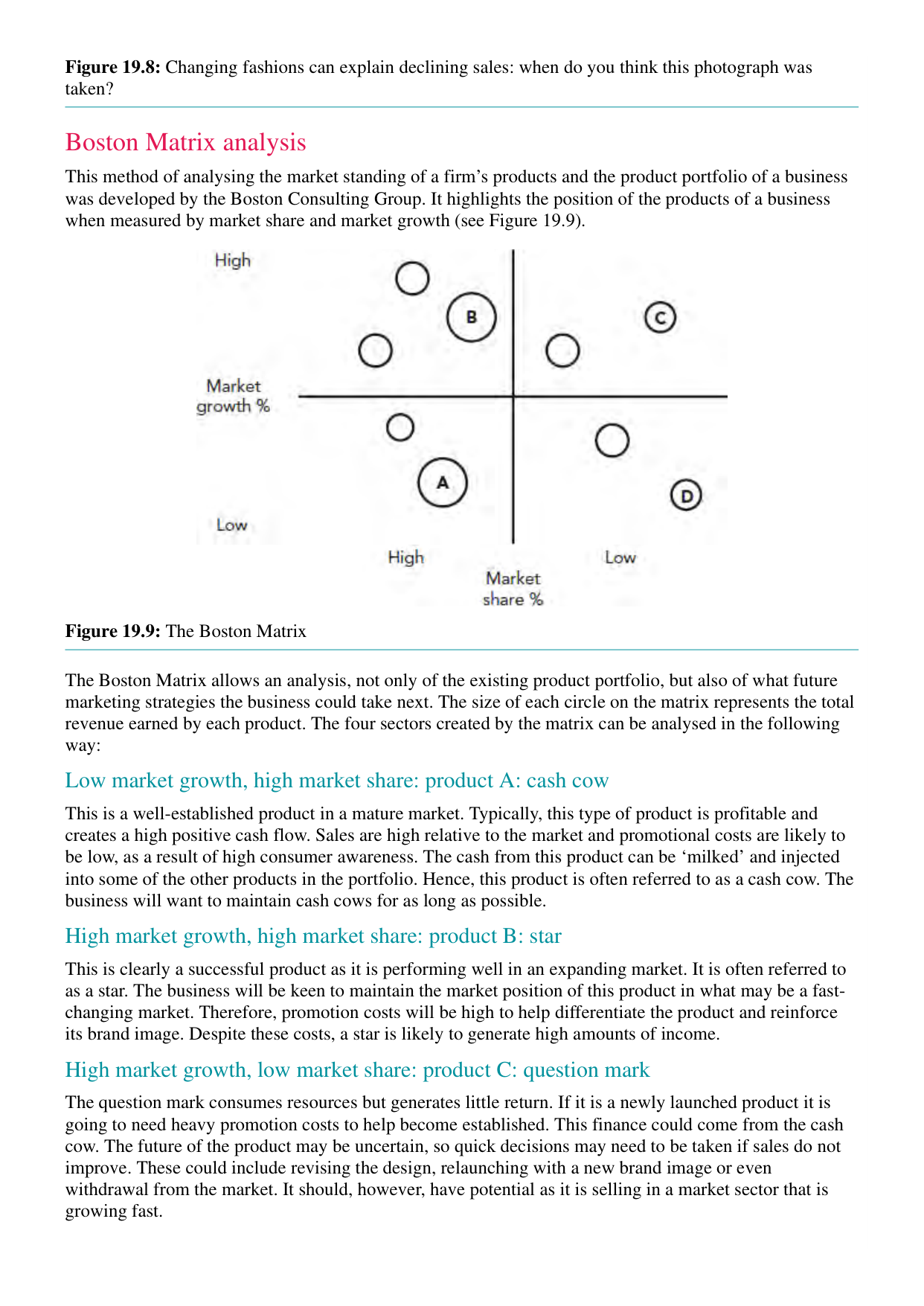
The Cash-Recycling Life Cycle in BCG:
\text{Question Mark (Infancy)} \xrightarrow{\text{Invest Cash Cow Profits}} \text{Star (Growth)} \xrightarrow{\text{Market Matures}} \text{Cash Cow (Maturity)} \xrightarrow{\text{Market Shrinks}} \text{Dog (Decline)}
Part B: The Ansoff Growth Matrix & Risk Ladder
The Ansoff Growth Matrix: Strategic Risk Progression
| Strategic Choice | Product Strategy | Target Market | Risk Profile & Example |
|---|---|---|---|
| 1. Market Penetration | Existing Product | Existing Market | Lowest Risk: Promotions, loyalty discounts, capturing rival share |
| 2. Product Development | New Product | Existing Market | Moderate Risk: BreadTalk launching oat-milk bread for current customers |
| 3. Market Development | Existing Product | New Market | Moderate Risk: Exporting proven bakery products to Indonesia/Vietnam |
| 4. Diversification | New Product | New Market | Highest Risk: Bakery chain entering commercial fitness gyms |
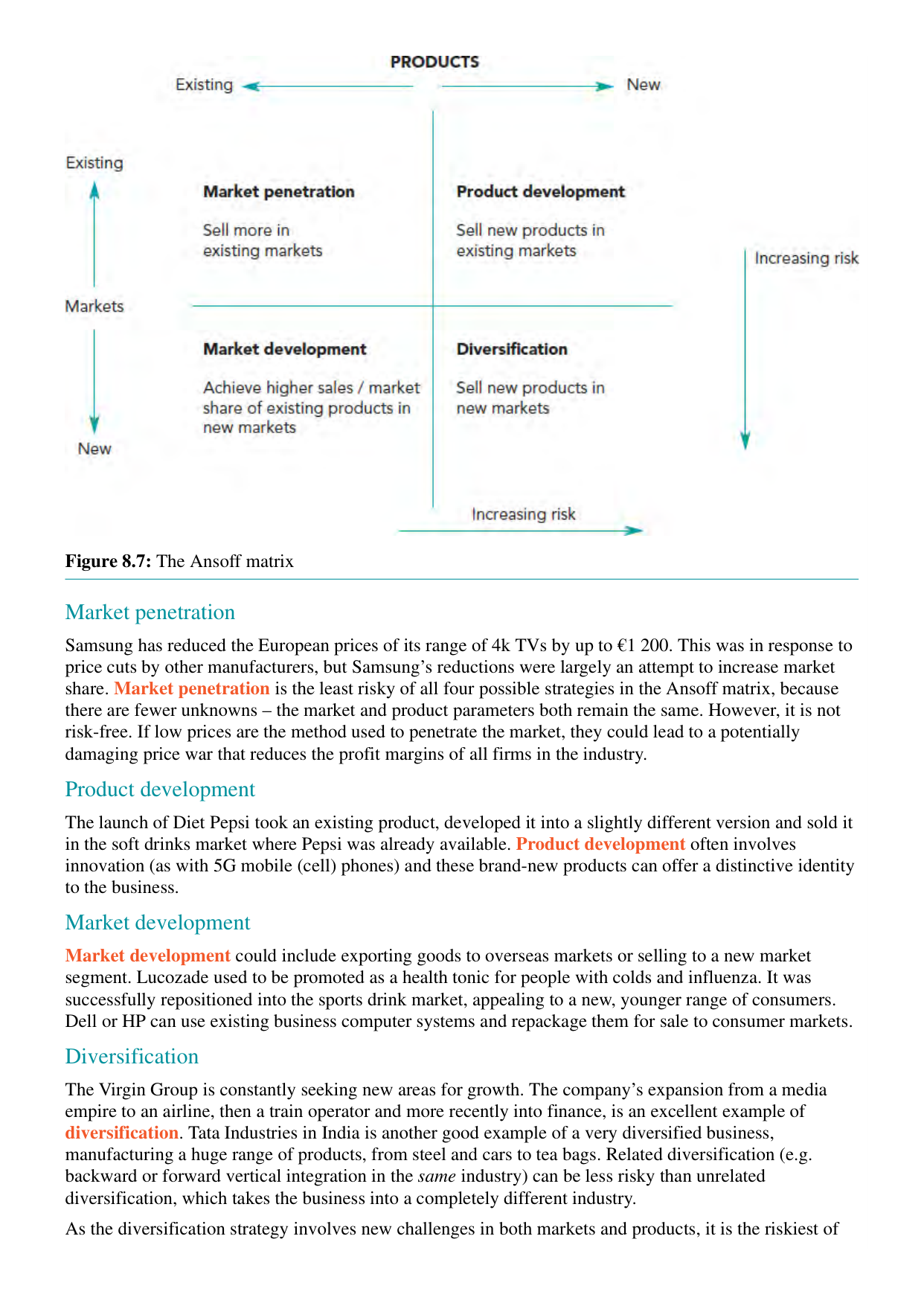
The Ansoff Risk Ladder Explained:
- Market Penetration (Lowest Risk): Firm operates in familiar markets with proven products. Risk is low, but growth potential is limited once the domestic market reaches saturation.
- Product Development (Moderate Risk): Firm leverages its existing brand reputation and established customer distribution channels, but faces product R&D, manufacturing, and failure risks.
- Market Development (Moderate Risk): Firm leverages its proven, manufactured product, but faces unfamiliar foreign regulatory environments, foreign exchange volatility, and local cultural differences.
- Diversification (Highest Risk): Simultaneous departure from familiar products and familiar customer segments. High probability of commercial failure (>70%).
4. Check Your Understanding
🧠 Diagnostic Portfolio Exercise:
Singapore beverage company Tropicool analyzes its product lines:
- Product A (Classic Orange Juice): 45% market share in a mature market growing at 1% per year.
- Product B (Organic Cold-Pressed Health Shot): 10% market share in a booming wellness market growing at 28% per year.
- Product C (Sparkling Vitamin Water): 40% market share in a fast-growing segment expanding at 22% per year.
- Product D (Diet Artificial Sweetener Soda): 4% market share in a shrinking market declining at -8% per year.
- Classify Products A, B, C, and D into their respective BCG quadrants.
- Formulate the strategic cash-allocation plan between Product A, B, C, and D.
- If Tropicool decides to export Product A to Vietnam, which Ansoff strategy is being executed?
👉 Click to reveal model classification & strategy
BCG Classification:
- Product A: Cash Cow (High Share, Low Growth)
- Product B: Question Mark / Problem Child (Low Share, High Growth)
- Product C: Star (High Share, High Growth)
- Product D: Dog (Low Share, Negative/Low Growth)
Strategic Resource Allocation Plan:
- Milk Product A (Cash Cow): Harvest its substantial operating cash surplus with minimal marketing reinvestment.
- Invest in Product C (Star): Reinvest cash to defend market leadership against new entrants.
- Evaluate Product B (Question Mark): Channel surplus cash from Product A into Product B to build brand awareness and convert it into a future Star.
- Divest Product D (Dog): Eliminate advertising and phase out production to release working capital.
Ansoff Strategy: Market Development (selling existing Product A into a new geographic market, Vietnam).
5. Exam Error Surgery: Fix the Weak Answer
Paper 2 Case Study Prompt (10 marks): Evaluate the usefulness of the Boston Consulting Group (BCG) Matrix in helping a company make strategic product investment decisions.
“The BCG matrix is very useful because it has four boxes: Star, Cash Cow, Dog and Question Mark. Cash cows make a lot of money so you use the money to feed the stars and question marks. Dogs should be thrown away immediately because they lose money. Therefore, every company must use the BCG matrix to make decisions.”
🔴 Examiner Red-Pen Diagnosis:
- Oversimplified Mechanics (): Assumes all Dogs are loss-making and must be immediately dumped (some Dogs generate small cash profits or support other core product lines).
- Zero Critical Limitations (): Fails to analyze the matrix’s major analytical flaws: assumes market share is the only driver of profit, ignores competitive dynamics, and oversimplifies complex multi-attribute markets into 2 axes.
- No Evaluation (): Reaches an absolute, uncritical recommendation without conditionality.
[Analysis: Strategic Utility of the BCG Matrix]
The BCG Matrix provides senior executives with a powerful visual diagnostic to audit the balance of their product portfolio. By categorizing products along Market Growth and Relative Market Share axes, management can systematically manage corporate cash flows: harvesting the cash surpluses of mature Cash Cows to fund the aggressive marketing and R&D requirements of Stars and high-potential Question Marks. This prevents management from starving future revenue engines or over-investing in declining markets.
[Analysis: Critical Theoretical and Practical Limitations]
However, the BCG Matrix carries severe strategic limitations:
- Oversimplified Determinants of Profitability: The model assumes that high market share automatically delivers low unit costs (via scale economies) and high profits. In reality, a firm in a low-share niche can be exceptionally profitable through premium pricing, while a market-share leader can be unprofitable due to price wars.
- Dynamic Market Fluidity: It represents a static snapshot; fast-moving digital industries experience rapid product obsolescence, making historical growth classifications misleading.
- Strategic Value of “Dogs”: Prematurely divesting a “Dog” may destroy vital customer goodwill if the product complements a core Star product (e.g. printer ink or replacement spare parts).
[ Evaluative Judgment & Synthesis]
In conclusion, the BCG Matrix is useful as an initial diagnostic screening tool, but must never be used in isolation:
6. Strategic Evaluation Matrix
| Ansoff Strategy | Risk Level | Capital Requirement | Primary Success Condition | Major Failure Mode |
|---|---|---|---|---|
| Market Penetration | Lowest | Low (Promotions, pricing) | Growing or fragmented domestic market. | Price wars; market saturation; diminishing returns. |
| Product Development | Moderate | High (R&D, tooling, testing) | Strong existing brand loyalty & customer database. | Technical R&D failure; cannibalization of existing products. |
| Market Development | Moderate | Medium (Distribution, export setup) | Proven domestic product; scalable logistics. | Cultural mismatch; foreign regulatory barriers; FX volatility. |
| Diversification | Highest | Massive (Acquisitions, new capabilities) | Synergistic capabilities or deep corporate cash reserves. | Lack of industry expertise; management distraction (>70\% failure). |
7. “I Do / We Do / You Do” Exam Scaffolds
“I Do” Annotated Model Answer (12 marks)
Question: Evaluate whether a Singapore luxury hotel chain should pursue diversification into branded luxury residences or market development by opening hotels in secondary regional cities.
[/ Definition & Context]
Diversification involves launching a new product into a new market (e.g. residential property development), whereas Market Development involves taking the existing hotel service into new geographic territories (e.g. Tier-2 Asian cities).
[ Analysis: Case for Market Development (Lower Risk & Core Competency)]
Market Development leverages the hotel’s established operational core competencies in luxury hospitality management, guest service protocols, and global reservation systems. By expanding into high-growth secondary regional cities (e.g. Da Nang or Chiang Mai), the chain captures emerging tourist and business flows while utilizing its proven operational model. This represents a moderate risk profile because the service delivery mechanics remain completely familiar to management.
[ Analysis: Case for Diversification (High Margin vs High Execution Risk)]
Conversely, diversifying into branded luxury residential property allows the chain to monetize its prestigious brand equity, capturing massive upfront capital cash inflows from ultra-high-net-worth real estate buyers. However, residential property development requires completely alien competencies: land zoning negotiations, construction risk management, and complex real estate legal compliance. If construction costs escalate or property markets slump, the financial exposure can jeopardize the core hotel business.
[ Evaluative Judgment]
In conclusion, the hotel chain should prioritize Market Development over Diversification:
- Market Development exploits existing hospitality expertise with significantly lower operational and financial downside risk.
- If management wishes to capture residential property value, it should avoid direct development and execute a licensing / branding agreement with an established local property developer, capturing brand royalties while insulating the hotel from construction and balance sheet debt risks.
“We Do” Guided Practice Scaffold
Question: Explain why a company with multiple “Question Mark” products and zero “Cash Cows” faces high financial risk (6 marks).
Complete the analytical sentences using the provided sentence frames:
- [Cash Drain of Question Marks] Question Marks operate in high-growth markets where competition is intense, meaning they require massive ongoing cash investment in \dots (Hint: explain what marketing and capital spending is needed to build market share).
- [Absence of Cash Cow Funding] Because the company possesses zero Cash Cows, it lacks a stable internal source of operating cash surplus, which forces the business to \dots (Hint: explain why relying on expensive external bank loans or issuing shares creates financial distress).
“You Do” Independent Exam Practice
25-Mark Essay Prompt: “Evaluate the view that for a consumer goods company in a small domestic economy like Singapore, Market Development into overseas markets is the only viable long-term growth strategy.”
Guided Success Criteria:
8. Self-Diagnosis & Retrieval Matrix
| Syllabus Sub-Topic | Can I explain in Plain English? | Can I provide a Singapore Case? | Can I evaluate the Trade-off? |
|---|---|---|---|
| BCG Matrix (4 Quadrants) | ⬜ | ⬜ (BreadTalk portfolio mapping) | ⬜ (Milking cows vs Star investment) |
| BCG Cash-Recycling Loop | ⬜ | ⬜ (Cash Cow funding Question Mark) | ⬜ (Portfolio balance vs Over-diversification) |
| Ansoff Matrix (4 Strategies) | ⬜ | ⬜ (Oatside export vs New product) | ⬜ (Penetration safety vs Diversification risk) |
| Ansoff Risk Ladder | ⬜ | ⬜ (Familiarity vs Unknown capabilities) | ⬜ (Domestic saturation vs Overseas risk) |