6.2 Strategic Analysis: Governance, Internal & External Audits
Examiner Focus (Paper 2 Section B Core): Master the 3 core pillars of Strategic Analysis:
- Strategic Purpose: Mission, Vision, Values, Corporate Governance, Business Ethics & CSR.
- Internal Environment Audit: Resources, Capabilities, Core Competencies, Activities (SWOT Strengths & Weaknesses).
- External Environment Audit: PESTLE Macro-environment (§1.5) and Porter’s Five Forces (SWOT Opportunities & Threats).
1. Real-World Case Dilemma
Case Context: A Singapore offshore oil-and-gas engineering conglomerate generated record profits building deepwater oil drilling rigs in the 2010s:
Internal Audit: World-class heavy shipyard docks, thousands of skilled marine engineers, and deep balance sheet cash reserves (Internal Strengths).
External Audit: Global financial institutions began enforcing strict ESG (Environmental, Social, Governance) sustainability mandates, the Singapore Carbon Tax escalated (§1.5), and global offshore wind power demand exploded by 400% (External Threats & Opportunities).
Governance Dilemma: Should the board of directors continue building profitable fossil fuel rigs for short-term profit, or execute a multi-billion dollar strategic pivot into offshore renewable wind energy to align with global governance and environmental sustainability?
2. Key Terms & Jargon Decoder
| Syllabus Term | Plain English Meaning | Examiner Trap / Distinguishing Feature |
|---|---|---|
| Mission vs Vision | Mission: Why the business exists today
(purpose, core customers, primary value). Vision: Where the business aspires to be in 5–10 years (future strategic destination). |
A mission statement without action is just an empty slogan; vision must guide capital allocation (§6.4). |
| Corporate Governance | The framework of rules, relationships, systems, and processes by which a company is directed, controlled, and held accountable to shareholders and stakeholders. | Enforced by the Singapore Exchange (SGX) and MAS; prevents executive fraud, conflict of interest, and reckless risk-taking. |
| Conflict of Interest | A situation where a manager’s or director’s private personal interests clash with their official corporate duty to the business. | E.g. A procurement director secretly awarding a S$2 million contract to a catering firm owned by their spouse without competitive tender. |
| Resources vs Capabilities vs Core Competencies | • Resources: What the firm has (tangible
vans/factories; intangible patents/brand). • Capabilities: What the firm can do (coordinate complex global logistics). • Core Competency: What the firm does better than rivals that cannot be easily copied. |
Having resources does not equal having an advantage; it is the unique integration of resources into core competencies that drives success! |
| Porter’s Five Forces | An industry-level strategic framework analyzing the 5 structural competitive forces that determine long-term industry profitability. | High forces = Tough industry, thin margins (e.g. food delivery); Low forces = Highly profitable industry (e.g. luxury monopoly). |
3. Concept & Visual Anchor
The Strategic Analysis Architecture
\text{1. Strategic Purpose \& Governance} \longrightarrow \text{2. Internal Audit [S/W]} + \text{3. External Audit [O/T]}
- 1. Strategic Purpose: Mission, Vision, Core Values, Board Governance, Business Ethics & CSR.
- 2. Internal Audit: Resources, Capabilities, Core Competencies, Value-Chain Activities \rightarrow SWOT [S] & [W].
- 3. External Audit: Macro PESTLE (§1.5) & Industry Five Forces $ ightarrow$ SWOT [O] & [T].
Part 1: Internal Environment Audit (Resources \rightarrow Core Competencies)
The Core Competency Value Chain
\begin{gathered} \textbf{Tangible & Intangible Resources} \longrightarrow \textbf{Dynamic Organizational Capabilities} \longrightarrow \textbf{Inimitable Core Competencies} \\ \text{[e.g. Modern Fleet + Balance Sheet Cash]} \longrightarrow \text{[e.g. 25-min Turnaround Operations]} \longrightarrow \text{[e.g. SIA World-Class Service Culture]} \end{gathered}
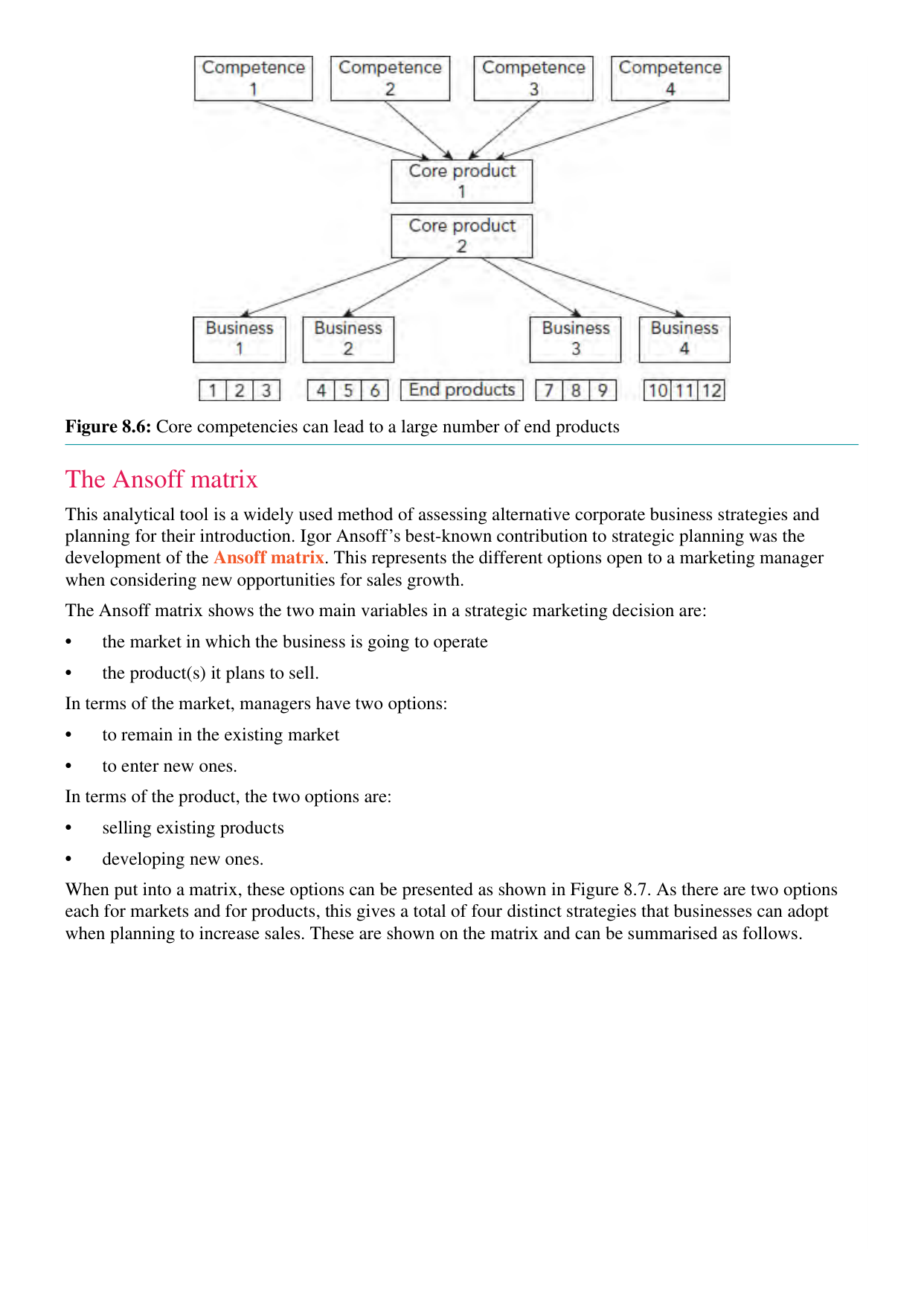
The 4 Tests of a True Core Competency (VRIO Framework):
- Valuable: Does it help the firm neutralize market threats or exploit consumer demand?
- Rare: Is it controlled by only a tiny handful of competing firms?
- Inimitable (Costly to Copy): Would it take competitors decades, millions of dollars, or complex cultural overhauls to replicate?
- Organised to Exploit: Does the company possess the organizational structure (§2.2) and leadership (§2.4) to leverage it?
Part 2: External Environment Audit (Porter’s Five Forces)
Porter’s Five Forces Framework
- 1. Threat of New Entrants: Ease of market entry; capital barriers, licensing, brand loyalty.
- 2. Bargaining Power of Buyers: Customer price sensitivity, purchase volume, number of substitute choices.
- 3. Threat of Substitute Products: Alternative categories offering superior price-performance utility.
- 4. Bargaining Power of Suppliers: Degree of monopoly supplier concentration and component uniqueness.
- 5. Rivalry Among Existing Competitors: Competitor density, industry growth rate, and exit barriers.
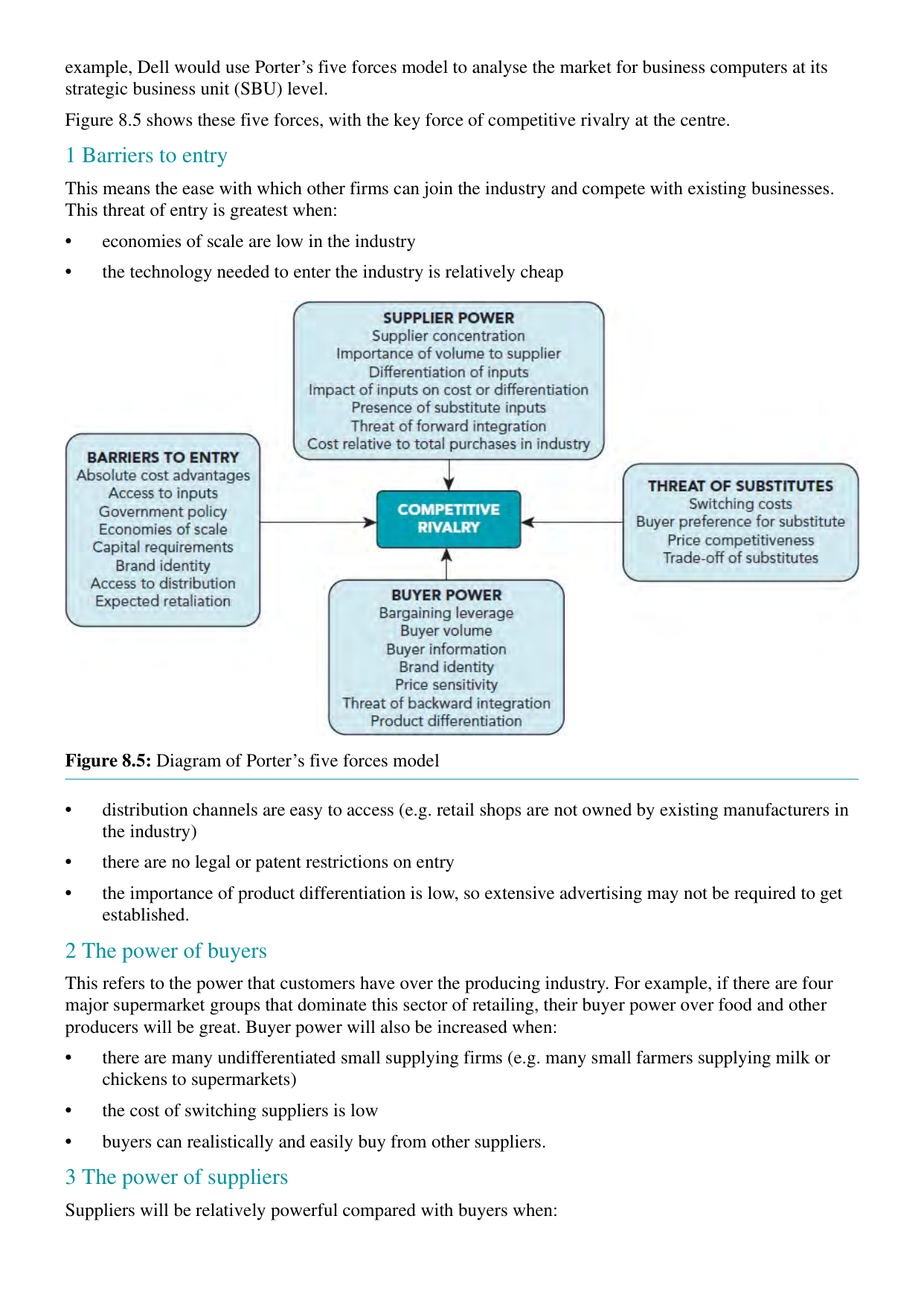
Deep-Dive into the 5 Industry Forces:
| Competitive Force | High Threat When… | Commercial Consequence |
|---|---|---|
| 1. Rivalry Among Existing Competitors | • Many competitors of similar size. • Slow industry growth. • Low customer switching costs. |
Severe price wars, escalating marketing costs, and compressed industry profit margins. |
| 2. Threat of New Entrants | • Low initial capital needed to start up. • Zero government regulatory licensing barriers. • Standardized, non-proprietary technology. |
Constant influx of new competitors undercutting prices, eroding market share. |
| 3. Threat of Substitutes | • Close substitute products offer superior price-performance. • Zero switching cost to switch categories (e.g. MRT train vs taxi). |
Places an absolute ceiling on the prices a business can charge. |
| 4. Bargaining Power of Buyers | • Few large buyers purchasing in huge bulk (e.g. FairPrice buying
from small food suppliers). • Buyers can easily switch brands. |
Buyers force down selling prices and demand expensive extended credit terms (§5.4). |
| 5. Bargaining Power of Suppliers | • Raw materials controlled by a few monopoly suppliers
(e.g. specialized semiconductor chip fabricators). • High supplier switching costs. |
Suppliers charge exorbitant raw material prices, causing cost-push margin compression. |
4. Check Your Understanding
🧠 Five Forces Strategic Diagnostic:
Evaluate the competitive forces facing a food delivery cloud-kitchen merchant in Singapore selling generic fried chicken on GrabFood/Foodpanda:
- Threat of New Entrants: [ High / Low ] — Justify why.
- Bargaining Power of Buyers: [ High / Low ] — Justify why.
- Bargaining Power of Delivery Platform (Supplier): [ High / Low ] — Justify why.
- Overall Industry Profitability Verdict: State whether this industry is structurally attractive or unattractive.
👉 Click to reveal model five forces audit
- New Entrants = HIGH: Extremely low capital needed to rent a shared kitchen burner and list on an app; hundreds of new home and commercial cooks enter monthly.
- Buyer Power = HIGH: Consumers face zero switching costs; they can tap to order from 50 competing fried chicken merchants on the app with a single click.
- Platform Supplier Power = HIGH: GrabFood/Foodpanda control customer access and dictate non-negotiable 30% commission rates.
- Verdict = STRUCTURALLY UNATTRACTIVE: High entry threats, extreme buyer power, and powerful platform intermediaries make this a low-margin, high-attrition industry. The only path to survival is creating powerful Product Differentiation (§6.3) or a proprietary direct-to-consumer loyalty app to escape platform dominance.
5. Exam Error Surgery: Fix the Weak Answer
Paper 2 Section B Strategic Essay Prompt (20 marks): Evaluate the internal core competencies and external industry forces that determine the strategic success of a national carrier like Singapore Airlines (SIA).
“SIA is very successful because it has a lot of airplanes and nice flight attendants. Its strength is having a lot of money and good food. The Five Forces are competitors like Scoot and Emirates. The threat of new entrants is low because planes are expensive. Buyers have power because they can choose other airlines. Therefore SIA should buy more planes to stay strong.”
🔴 Examiner Red-Pen Diagnosis:
- Confuses Resources with Competencies (): Lists physical airplanes as a strength (planes are generic assets that any rival can buy; they are not core competencies).
- Flawed Application (): Mentions Scoot as a competitor (Scoot is SIA Group’s own subsidiary, not an external rival).
- Superficial Five Forces Analysis (): Fails to analyze substitute threats (high-speed rail, video conferencing) or supplier power (Boeing/Airbus duopoly).
- Vague Recommendation (): Suggests “buying more planes” without evaluating debt gearing or capital returns (§5.6).
[Analysis: Internal Core Competencies Audit]
SIA’s competitive advantage does not stem from its physical aircraft fleet (which are generic tangible resources available on the open market to any well-funded rival). Instead, SIA’s true Core Competency is its deeply embedded institutional culture of service excellence and cabin hospitality (§6.4). This capability is built on rigorous 15-week training regimens, deep organizational knowledge, and continuous process refinement that competitors cannot easily reverse-engineer or poach (Inimitable VRIO capability). This core competency powers a Differentiation Strategy (§6.3), allowing SIA to command substantial price premiums from affluent leisure and corporate business travelers.
[Analysis: External Five Forces Industry Audit]
However, SIA operates in a structurally hostile global airline industry characterized by intense Five Forces pressures:
- Intense Global Rivalry & Capacity Dumping: Well-funded state-backed Middle Eastern carriers (Emirates, Qatar Airways) and aggressive low-cost carriers generate chronic industry seat-capacity gluts, triggering periodic price wars.
- Extreme Supplier Power (Boeing & Airbus Duopoly): Aircraft and jet engine suppliers operate as powerful duopolies with massive pricing power and multi-year order backlogs, leaving airlines with high capital acquisition and maintenance expenses.
- High Threat of Substitutes & Economic Shocks: Corporate business travel faces structural substitution from digital video conferencing platforms (Zoom/Teams), while geopolitical fuel price shocks (§1.4) directly inflate operating expenses.
[ Evaluative Judgment & Synthesis]
In conclusion, SIA’s strategic success requires a dynamic alignment between internal competencies and external forces:
- SIA cannot compete on price against state-subsidized carriers; it must relentlessly defend its service differentiation core competency through continuous digital app enhancements and cabin seat innovation.
- Simultaneously, to neutralize low-cost airline entry, SIA Group executed a Dual-Brand Corporate Strategy (§3.4)—deploying wholly owned subsidiary Scoot to capture price-sensitive leisure travelers, thereby insulating the mainline luxury SIA brand from commoditisation.
6. Strategic Evaluation Matrix
| Strategic Analysis Tool | Primary Strategic Purpose | Critical Blind Spot / Limitation |
|---|---|---|
| Mission / Vision / Values | Establishes organizational purpose, guides capital allocation, and aligns employee culture. | Can degenerate into empty corporate slogans if executive compensation and daily decisions contradict stated values. |
| Corporate Governance & Ethics | Prevents executive fraud, ensures legal compliance (PDPA, SFA), and protects shareholder equity. | Heavy governance and compliance committees can slow down strategic decision agility. |
| VRIO Core Competency Audit | Identifies internal capabilities that generate defensible, sustainable competitive advantages. | Inward-looking bias: An internal capability is worthless if external consumer demand shifts away from it. |
| Porter’s Five Forces | Assesses industry attractiveness and uncovers where commercial profit power resides. | Static snapshot; ignores rapid cross-industry tech disruption and cooperative business ecosystems. |
| SWOT Matrix | Synthesizes Internal [S/W] with External [O/T] to generate actionable strategic choices (§6.3). | Subjective and qualitative; risks producing a laundry list of points without strategic prioritization. |
7. “I Do / We Do / You Do” Exam Scaffolds
“I Do” Annotated Model Answer (20 marks)
Question: Evaluate whether a company’s mission statement and corporate social responsibility (CSR) initiatives are genuinely valuable strategic tools or merely public relations marketing exercises.
[/ Definition & Context]
A mission statement articulates a business’s fundamental purpose and values, while Corporate Social Responsibility (CSR) represents the integration of social, ethical, and environmental considerations into corporate decision-making (§1.1).
[ Analysis: Case for Mission & CSR as Genuinely Valuable Strategic Tools]
When deeply integrated into executive decision-making, mission statements and CSR serve as powerful drivers of sustained competitive advantage (§6.1):
- Strategic Cohesion and Capital Discipline: A clear, authentic mission acts as a strategic filter, preventing management from squandering capital on unviable diversification (§6.3) that contradicts the firm’s core purpose.
- Talent Attraction and Employee Motivation (§2.5): Top-tier educated knowledge workers increasingly seek purpose-driven employers. An authentic CSR culture satisfies higher-order self-actualisation needs (Maslow), driving lower recruitment costs, reduced talent turnover, and higher labor productivity per worker-hour (§4.4).
- Insulation from Regulatory & Reputational Penalties (§1.5): Proactive CSR in environmental decarbonization insulates the business from escalating Singapore Carbon Taxes and attracts institutional ESG investment capital (§5.2).
[ Analysis: The Cynical Counter-Reality — “Greenwashing” & PR Façade]
However, mission statements and CSR frequently degenerate into superficial “Greenwashing” PR marketing gimmicks. When a company publishes grand environmental mission statements on social media while secretly cutting corners on worker safety, underpaying supply chain workers, or using misleading marketing claims (§3.5), the hypocrisy is rapidly exposed on digital media. The resulting consumer backlash and regulatory investigations (e.g. CASE, MOM, or SFA penalties) cause catastrophic brand equity destruction that far exceeds any temporary marketing gain.
[ Evaluative Judgment & Synthesis]
In conclusion, the strategic value of a mission statement and CSR depends strictly on Corporate Governance and Decision Alignment:
- If CSR is managed merely as an advertising campaign by the marketing department, it is a dangerous PR gimmick with high reputational downside.
- For CSR to be a genuine strategic tool, it must be embedded in the boardroom governance structure: tying executive bonuses directly to ESG and ethical compliance metrics (§6.4), ensuring that daily operational choices align strictly with the stated mission.
“We Do” Guided Practice Scaffold
Question: Explain how strong supplier bargaining power in the semiconductor chip industry impacts the profitability of consumer electronics manufacturers (6 marks).
Complete the analytical sentences using the provided sentence frames:
- [Supplier Monopoly & Pricing Power] Because advanced semiconductor fabrication is concentrated among a tiny monopoly of specialized chipmakers (e.g. TSMC), electronics manufacturers have zero alternative suppliers, allowing chipmakers to \dots (Hint: explain how suppliers can charge exorbitant component prices and demand strict payment terms).
- [Profit Margin Compression] Electronics manufacturers cannot easily pass these massive component cost increases to price-sensitive retail consumers, which directly \dots (Hint: explain the mathematical impact on gross and net profit margins).
“You Do” Independent Exam Practice
Paper 2 Section B 20-Mark Essay Prompt: “Evaluate the view that for an established business, an internal audit of core competencies is far more important in formulating strategy than an external analysis of industry competitive forces.”
Guided Success Criteria:
8. Self-Diagnosis & Retrieval Matrix
| Syllabus Sub-Topic | Can I explain in Plain English? | Can I provide a Singapore Case? | Can I evaluate the Trade-off? |
|---|---|---|---|
| Mission, Vision, Core Values | ⬜ | ⬜ (SIA service vision vs Stated slogan) | ⬜ (Strategic guide vs Empty PR) |
| Corporate Governance & Ethics | ⬜ | ⬜ (SGX listing rules / Conflict of interest) | ⬜ (Governance rigor vs Decision speed) |
| Resources vs Core Competencies | ⬜ | ⬜ (SIA planes vs Cabin service culture) | ⬜ (Tangible asset vs Inimitable capability) |
| Porter’s Five Forces Model | ⬜ | ⬜ (Food delivery cloud kitchen audit) | ⬜ (Industry attractiveness vs Niche position) |
| Internal vs External SWOT Synthesis | ⬜ | ⬜ (Oil-rig builder green energy pivot) | ⬜ (Inside-out VRIO vs Outside-in PESTLE) |